[ Art of Mondays ]
Updated February 2026
Is Founder Sports Club Legit? How It Actually Works (2026)
If you're researching a paid membership, a few basic questions usually come first:
Is this real? How does it work? What if it doesn't meet my expectations?
This page answers all those questions for you.
We'll break down why some people question legitimacy in paid communities. We'll cover how Founder Sports Club works today and how things have changed since earlier versions. And also what systems are now in place to protect member experience.
Further down, we'll cover payments, refunds, and cancellations. And we'll describe clearly what FSC is and what it's not, so you can evaluate it clearly before deciding whether to join.
On this page
Why People Question Legitimacy in Paid Communities
Skepticism around paid communities is reasonable, especially with products that rely on people's participation rather than a physical deliverable.
Unlike software or courses, the outcome in a community product depends on people actually showing up. Attendance, participation, and follow-through all influence the experience, which makes it harder to evaluate upfront.
On top of that, it can be hard to judge products because early iterations often look very different from what exists today.
These are structural challenges that apply to any paid, in-person community where the value emerges through participation rather than being delivered instantly.
Approaching these products with caution is reasonable. And it's a useful starting point for evaluating whether the systems behind a community are strong enough to support the experience it offers.
How Founder Sports Club Actually Works Today
Founder Sports Club operates on a simple, repeatable monthly system designed to reduce manual coordination.
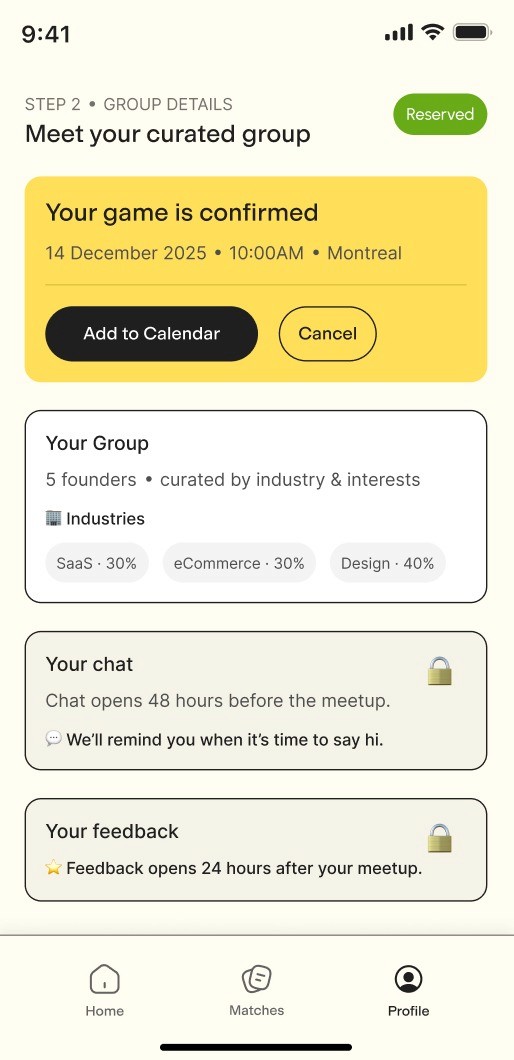
Each month, members must opt-in via the app or web app before the 1st day of the next month. For example, members who want to attend a meetup in February must opt-in during January.
Then on the 1st day of the month, members will be placed in a group of 4-5 other founders. These groups are created based on a similar location, similar revenue range, and similar industry. This is done so people are meeting others at a similar stage of business to them.
Meetups are always at 10am on the second Sunday of the month. The time and day are set for the group by FSC to remove the need for members to organise logistics themselves. The only input required from members is choosing the sport or activity they want to do, which is done in a group chat that opens 48h before the meetup.
The cadence is always monthly. Members are matched once per month and attend one in-person meetup per cycle. This fixed rhythm is intentional. It creates consistency by letting people work FSC into their routines and plan ahead, knowing when their meetup will be.
What Went Wrong in FSC 1.0 (and Why It's Different Now)
The first version of Founder Sports Club exposed some weaknesses that made meeting up harder than it needed to be.
The biggest issue was over reliance on self-coordination. Groups had to organise times, locations, and plans themselves, rather than having a done-for-you system.
There were also no consequences for inactivity. Members who didn't engage could remain in groups indefinitely.
Communication was fragmented as well. Without a central platform, messages were spread across email and external chats (like WhatsApp), making it easy for plans to be missed.
What changed structurally
FSC now requires members to opt-in before being matched in a group. This means they commit to meeting up at the designated time and day before deciding to participate each month.
The current system also removes coordination from the members wherever possible. Meetups are automatically scheduled inside the app, communication lives in one place in the in-app group chat, and participation is monitored by the FSC team.
Inactivity is watched and managed, and members who repeatedly do not engage are removed to keep groups reliable.
Why these changes matter
These shifts move responsibility from members to the product itself. Instead of relying on people's motivation, FSC now enforces participation standards, reduces decisions for members, and creates a predictable monthly flow.
How FSC Protects Member Experience
Founder Sports Club is structured to maintain the quality of member experiences by creating reliable systems rather than leaning on individual behaviour.
Every new member is manually reviewed before joining. This is not about exclusivity. It's about filtering for alignment and commitment so groups are made with people who intend to participate.
Inactive members are removed. If someone repeatedly doesn't engage or show up, they're taken out of the matching pool. This stops inactive members from dragging down an entire group and keeps participation standards clear.
Members can also rate each other by reporting others' meetup attendance, giving star-rating reviews, and optional comments. This adds an additional layer of feedback that allows members to flag inactive or misbehaved members to us.
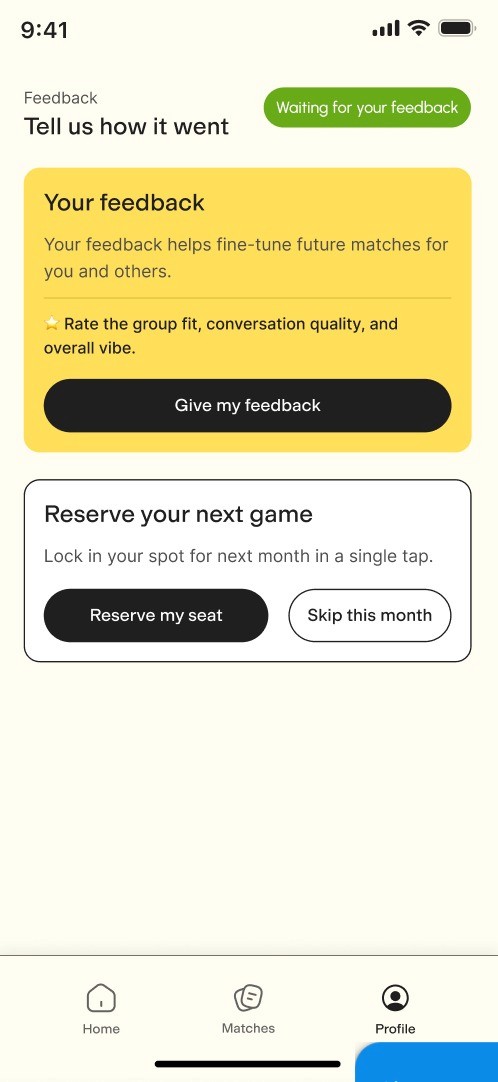
Scheduling is centralised in the FSC app. Meetups are set by FSC and the time and place is scheduled in advance. This removes the coordination burden that can cause friction and drop-offs.
Expectations are laid out from the start. Members know the level of commitment required and how participation is evaluated. This is intentional, it allows people to opt in with eyes open or opt out without friction if the format doesn't suit them.
Payments, Refunds & Cancellations
This section outlines how billing works and what options exist if the experience doesn't meet expectations.
How billing works
Founder Sports Club operates on a quarterly subscription. Members are charged on a rolling basis every 3 months and can cancel at any time.
When refunds apply
Refunds are available in three situations:
If a member has attended at least one meetup and feels like the experience wasn't a fit, they may request a refund.
If a member hasn't been matched for three consecutive months due to insufficient numbers in their city, they may request a refund.
If a member has been matched in a group for three consecutive months and makes meaningful attempts to meet up but can't attend any due to other members being inactive, they may request a refund.
These refunds aim to be fair to members given the reality of running local, in person groups.
How cancellations work
If a member cancels, their subscription remains active until the end of the current billing period. They can keep using the app and participate during that time.
Cancellations can be completed directly through the app by going to Profile → Manage Subscription, or by emailing sports@artofmondays.com.
What happens if expectations aren't met
If someone is unsure whether they qualify for a refund, wants help before cancelling, or has feedback about their experience, they can contact sports@artofmondays.com.
Support responds directly and looks for a solution that works. The goal is to resolve the issue fairly, not retain members at all costs.
What FSC Is, and What It Isn't
There are lots of forms of in-person networking events out there. So it's worth clearing up exactly what FSC is.
What FSC is
Founder Sports Club is about making meaningful and friendly connections with a small group of founders over sport.
Meetups happen once per month with a new group of founders each time. And they're structured so that FSC coordinates the day, time, and location of the meetup.
Meetups are a low-pressure environment. They're designed to be fun and easy-going, making it easier to get to know other members and form meaningful connections.
What FSC isn't
FSC isn't guaranteed ROI networking. It's not about getting deals, clients, or measurable business outcomes from each meetup.
It's not a mastermind either. There is no curriculum, facilitated discussion, or set structure.
And it's not a lead generation funnel. FSC isn't designed for selling, prospecting, or list building.
These facts are important. FSC works for members who join for consistent, in-person connection, not for a transactional business tool.
Final Take
Founder Sports Club is a paid product with systems, member protections, and operating rules behind it.
It's also not for everyone. FSC is deliberate in what it offers and in how it operates, which means it will feel useful to some founders and misaligned for others.
It works best for founders who value consistency and structure over spontaneity. And who want in-person connection without the pressure of extracting immediate business results.
If you want to explore further, you can review real member experiences here.
If this sounds like something that could work for you, you can apply to join below.
[ Art of Mondays ]