[ Art of Mondays ]
Updated February 2026
Founder Sports Club, or FSC, is a membership community that connects founders through monthly, in-person sports meetups. Members get matched with a small group of other founders in their city and organise something active together.
This page covers what happens after you join, member experiences, past product challenges, and how FSC has evolved over time. It gives a clear picture of what it is, what it is not, and whether it might make sense for you.
On this page

Founder Sports Club is a simple way for founders to meet other founders, without the awkwardness of networking events.
Each month, members are matched into small, local groups and meet in person to play sport together. Runs, workouts, pickleball, whatever fits. The point is to move your body and spend time with like-minded people who get what it's like to build a business.
It is low pressure by design. No pitching. No forced chats. You show up, play, and hang out.
FSC is built around consistency, not one-off events. The same rhythm every month, with people in your city, so connection has time to compound.
How it works today
The time, day, and location of meetups are auto-scheduled each month. All groups have to do is decide on their favourite sport to play
Members must opt-in to be matched before the first day of each month to be placed in a group
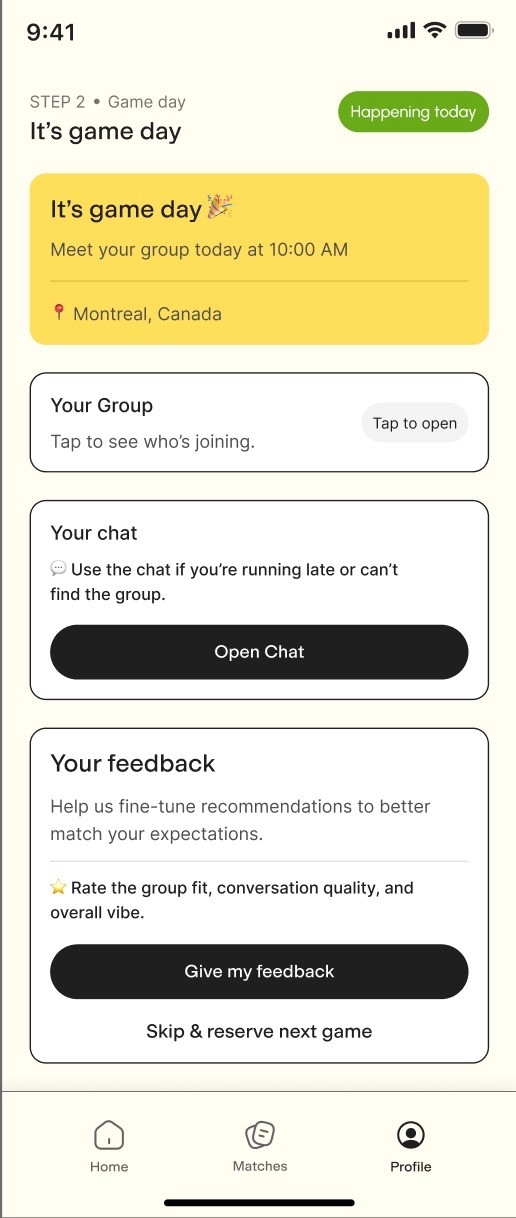
All communication happens inside the FSC app, including meetup details, group details, and a group chat. The app is available on iOS and Android. It's also available in a web-app version, however we don't recommend this to members as it can't send notifications which could lead to missed messages and matches.
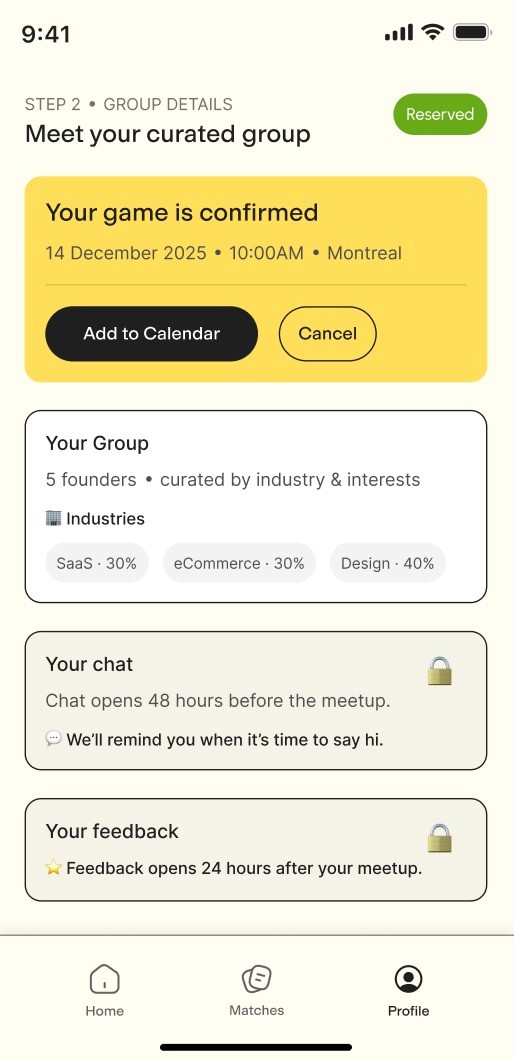
Members who are reported and/or stop showing up are removed to keep the groups reliable
Members can provide feedback about their group matches and report inactive people
It's meant to feel easy to say yes to and just as easy to step back when life gets busy
Member feedback is what drives each iteration and improvement of the Founder Sports Club.
Over the past year, a few patterns have shown up pretty consistently.
From current members, the biggest win is that meetups happen more often.
Because matches are handled automatically and groups are small, there is way less back-and-forth than traditional networking or free community events. People know when they're meeting, who they're meeting, and why they are there.
Founders also mention that conversation feels easier. Playing a sport together removes the awkwardness, so talking feels natural instead of forced. And compared to open, free events, the monthly cycle makes it easier to stay involved instead of drifting away.
It hasn't always been perfect, and that matters too.
In the early FSC 1.0 days, some groups struggled. Meetups fell through, coordination relied too heavily on individual members, and engagement could vary a lot depending on the group.
Common feedback was that there was a lot of friction in the way it worked, with members having to coordinate their own meetups and try to align four busy schedules by themselves.
We learned a lot while building FSC 1.0, our MVP of the product. There were some real frustrations from members, and it's worth pointing out what didn't work in earlier versions of FSC.
Unresponsive Members
In FSC 1.0, everything relied on manual coordination between members.
If one person went quiet, replied late, or dropped off completely, the whole meetup could stall. That created friction for people who were keen to show up but felt stuck waiting on others.
This was one of the most common points of feedback in the early days and a big signal that the system needed more structure.
Early Platform Limitations
There was no central place to manage plans and communication.
Before the app, the MVP consisted of emails and WhatsApp groups. Communication was scattered and hard to keep track of.
Messages were missed. It was hard to tell who was active and who wasn't. And there was no clear feedback loop to improve the experience over time.
Too Much Back and Forth
Earlier groups also had to figure everything out themselves.
What sport to do. What time worked. Where to meet. Who was booking what.
For busy founders, that level of coordination often became a blocker. People had good intentions, but calendars fill up quickly. And suddenly the meetup never happened.
The issue wasn't about motivation. There was just simply too much friction.
The early feedback was taken on board. FSC 1.0 showed what people wanted, but it also showed where things didn't work. We used what we learned to shape the current product.
A few key changes were made after those early cycles.
All meetups now occur on the second Sunday of each month at 10am. That removes the need for group members to organise the meetup on their own. This addresses one of the biggest coordination blockers our earlier product had.
A few other things have also improved:
Members can provide feedback on the people they're matched with by leaving a rating and optional comment for each. The FSC team keeps track of people who are flagged as inactive in this feedback. And along with in-app tracking to identify inactivity, members who are repeatedly unresponsive are removed. This keeps groups active and protects the experience for people who actually want to show up.
All messaging now happens inside the FSC app. No lost emails. No guessing where the conversation lives. Everyone is in the same place.
Profiles and availability are kept up to date, so matches are based on real schedules.
Every new member is manually reviewed before joining. This filters out a lot of the issues that came from low-intent members early on.
The outcome
These changes have led to significantly more meetups taking place. The structure now removes the points where things used to stall or fade out.
There's less coordination, less chasing up, and fewer decisions to make. Which makes it easier for busy founders to attend without it becoming another task to manage.
This has led to higher show-up rates and more reliable groups.
Lucas R., 27 | Austin, US
“Honestly, I went expecting it́ it to feel like another commitment. But it was the easiest part of my month. Highly recommend.”

Verified Member
Chris, 24 | Denver, US
“I like sports, but most of my friends don’t play anything. FSC gave me a few people each month who were down to kick a ball or try padel. It’s now just part of my routine.”
Verified Member
Sung-ho, 33 | Seoul
“I’ve tried conferences, coworking, meetups… always felt forced. FSC is the first time I met founders in a way that felt natural. Zero awkwardness”
Verified Member
Marcus, 35 | Los Angeles
“CS is quick with memberships - had to pause mine. Also the feedback you submit in the app actually gets taken onboard, cheers for that”
Verified Member
Emily, 28 | Vancouver
“Been around since the email/WA days. The app was needed and the push from a scheduled time and a spot makes the meetups a lot more likely to go ahead. 3 in a row for me <3”
Verified Member
Harish, 31 | London
“My friends are great, but they don’t run businesses. Here, I didn’t have to explain context or translate anything. We just talked openly about work and life.”
Verified Member
Daniel, 32 | New York
“I was stuck in a loop of work–sleep–repeat. This month’s meetup gave me something to look forward to that wasn’t another task or goal. Sounds small, but it genuinely helped me reset.”
Verified Member
Camila, 28 | Lisbon
“I move cities every few months for work and it’s always the same problem: no community. With FSC, I update my location and get matched. It removes the effort of starting from zero every time.”
Verified Member
Alex, 31 | Amsterdam
“What surprised me most was how quickly conversations went deep. When you’re sweating and out of breath together, the walls drop fast.”
Verified Member
The Founder Sports Club offers a full money-back guarantee for all members who:
Have attended at least one meetup
Or
Weren't matched in a group for three consecutive months due to an insufficient number of members in their city.
If someone doesn't have a good experience, support responds directly, looks at the situation, and processes refunds quickly if they apply.
Members can also cancel their subscription at any time via the FSC app or by emailing sports@artofmondays.com. Cancellations take effect at the end of the billing period, so members can cancel and still participate until their membership expires.
Our cancellation and refund processes are set up to be straightforward and easy. They're not built around locking people into subscriptions. Instead, we aim to earn trust over time. Our perspective is that if the FSC experience is genuinely useful, people will stay. If it is not, they should be able to walk away easily.
The Founder Sports Club tends to work best for a specific kind of founder. Here's a breakdown of who it's for and who it's not for, so you can make an informed decision on whether it's right for you.
First, all members must own a business. Each account is manually reviewed by the FSC team and people who don't own a business are removed.
In general, FSC is likely a good fit if you are actively building a company and want to meet other founders in real life. Not just exchange messages online or connect on LinkedIn.
And of course, it's designed for people who love playing sports and trying new activities.
It also suits people who prefer in-person connection over online networking. And who like the idea of something recurring that they can include as part of their monthly schedule.
Additionally, FSC has a global presence in 80+ cities worldwide, making it a viable way to meet people for founders who travel a lot.
On the other hand, FSC may not be a fit if you're looking for a guaranteed ROI from networking or expecting direct business outcomes from every interaction.
If you prefer large conferences, pitch-style events, or rooms built around selling, FSC might feel too relaxed.
And if you don't enjoy sports or casual physical activity at all, the core format won't click. Movement isn't a side feature, it's the foundation of every meetup.
Is Founder Sports Club legit?
FSC has been running since 2024 and operates across dozens of cities, with thousands of founders using the product each year. Every new member is manually reviewed before joining and we do everything we can to keep the community free from inactive members. The FSC concept may not be for everyone. But for those who participate, FSC offers a real and valuable experience.
Why do some older reviews mention issues?
What happens if my meetup doesn’t happen?
If this sounds like something that could work for you, you can apply to join below.
[ Art of Mondays ]